Lessons from a Coaching Session | The Stress Bucket: Why Waiting Until You're Full is the Wrong Strategy
Let me ask you something. Have you ever had a week where everything just felt... too much? Where one extra email, one difficult conversation, one small thing going wrong was enough to tip you completely over the edge? And you found yourself thinking, "Why am I reacting like this? It's not even that bad."
Here's the thing. It probably wasn't that bad. But that's not really the point.
You've Been Carrying More Than You Realised
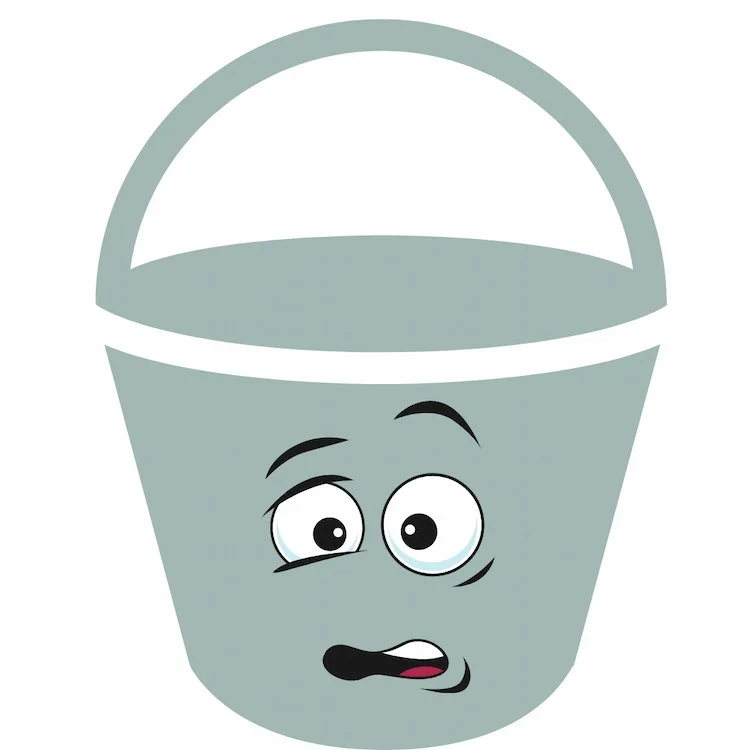
We all walk around, metaphorically speaking, with a stress bucket. It's not a clinical term, but it's one of the most useful descriptions I know. Your stress bucket is where everything goes: the big stuff, the small stuff, the stuff you've been quietly pushing down and ignoring for weeks.
Work pressures. Relationship tensions. Financial worries. A difficult commute. A health scare. A project that's been hanging over you. The news. That thing someone said two Tuesdays ago that you're still thinking about. All of it goes in.
And here's the part most people miss: there is always something in the bucket. Always. Life doesn't pause long enough for it to empty completely. Which means there is always some level of cortisol, our primary stress hormone, running through our system. Not necessarily in a dramatic, crisis-level way. Just... ticking away in the background. Because that's life.
The question isn't whether your bucket has anything in it. It's whether you have a strategy for managing it before it gets too full.
The Old Approach (and Why It Doesn't Work)
The traditional advice around stress management tends to go something like this: notice when you're struggling, then do something about it. Have a bath. Take a break. Book a holiday. Go for a walk. And yes, all of those things genuinely help. But they're reactive. They're what you reach for when you're already close to overflowing.
Most people I work with are brilliant at identifying their stress relief strategies. They know what helps. The problem is they only use them when they're already on the edge. And by that point, you're not choosing your coping strategies thoughtfully. You're just grabbing whatever's nearest, which, let's be honest, is often a large glass of wine and a Netflix spiral.
Waiting until you're nearly full to start releasing pressure means you're always playing catch-up. And that's exhausting in itself.
A Better Way: Make Holes in the Bucket
Here's the shift I encourage people to make. Instead of waiting until the bucket is almost full and then frantically trying to empty it, what if you made holes in it?
Small, intentional, regular holes that let stress release consistently, before it ever gets the chance to build up to crisis point. Not as a reaction to feeling awful. As a proactive part of how you live and work.
This changes everything. Because instead of stress management being the thing you do when you're struggling, it becomes the thing you do on a Tuesday afternoon when you feel absolutely fine. It becomes non-negotiable, like brushing your teeth. You don't wait until your teeth are falling out to start brushing them. The same logic applies here.
Your holes might look completely different to someone else's. That's the point. They need to be things that genuinely work for you, that you can realistically do regularly, and that you'll actually do rather than just intend to do.
Some people's holes are physical: a lunchtime walk, a workout, dancing around the kitchen (no judgement, I fully endorse this). Others are social: a proper catch-up with a friend, a laugh with a colleague. Some are creative, restful, musical, or involve a dog, a garden, or a really good book. The what matters less than the how often.
Try This
Take ten minutes and work through this.
Step 1: Draw a bucket and write inside it everything that is currently sitting in yours. Work, home, health, relationships, money, the general state of the world. Don't filter. Just get it out. Notice how much was already in there before today added anything new.
Step 2: Now, rather than drawing a tap on the side, draw holes along the bottom and sides of the bucket. These represent your regular, proactive stress-release strategies. The things that, done consistently, mean the contents never get the chance to build to dangerous levels.
Step 3: Write next to each hole what it represents for you. And then, honestly, ask yourself: how often am I actually doing these things? Daily? Weekly? Or only when I'm already struggling?
Step 4: Pick one hole you're not currently using regularly enough and commit to making it a non-negotiable this week. Just one. Build from there.
The goal isn't a spotless, empty bucket. That's not real life. The goal is a bucket that never overflows, because you're releasing a little, consistently, all the time.
This is the foundation of how I work with both individuals and organisations. Not crisis management, not sticking plasters, but building genuinely proactive habits that mean stress never gets to take over.
If you'd like to explore what that could look like for you or your team, I'd love to have that conversation. Get in touch.

Feeling overwhelmed by stress?
If stress is affecting you or your team, you don't have to face it alone. The Stress Specialist provides practical workshops, one-to-one coaching and workplace wellbeing programmes that help individuals and organisations build resilience, reduce stress and thrive.
Get in touch today to find out how we can support you or your organisation.